Loading
reCreating Europe
  • ABOUT
    • THE PROJECT
    • THE CONSORTIUM
    • PEOPLE
    • ADVISORY BOARD
  • STAKEHOLDERS
  • ACTIVITIES & RESOURCES
  • NEWS & EVENTS
  • NEWSLETTER
  • Menu Menu
  • Mail
  • Facebook
  • Twitter
  • Youtube
  • LinkedIn

Call For Papers – Workshop on Intellectual Property Rights in Szeged (WIPS)

January 26, 2022/in Activities /by Rosie Allison

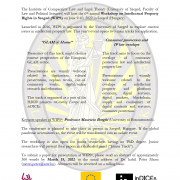
The reCreating Europe and inDICEs projects are co-organising the 6th annual Workshop on Intellectual Property Rights in Szeged (WIPS), hosted by The Institute of Comparative Law and Legal Theory (University of Szeged, Faculty of Law and Political Sciences) on June 9-10, 2022 in Szeged (Hungary).

Launched in 2016, WIPS is organized by the University of Szeged to explore current issues in intellectual property law. This year’s event opens two main tracks for application:

  • GLAM @ Home e.g.
    • current perspectives of the European GLAM sector;
    • digitization, cultural preservation, orphan works, out-of-commerce works, digital/online research and education.
  • Consumer protection and IP laws overlaps e.g.
    • overlaps of consumer protection law and intellectual property law;
    • overlaps of intellectual property and platform economy, digital services, digital markets, blockchains, supply and conformity of digital contents and services, and consumer protection.

Read more details here

To submit a paper for presentation for WIPS, please send an abstract of approximately 300 words to Péter Mezei (mezei.peter@szte.hu).

Deadline: March 15, 2022.

Please note that abstracts will be reviewed on a rolling basis.

https://staging.copyrightflexibilities.eu/wp-content/uploads/2022/01/Call-for-Papers_WIPS6_page-0001.jpg 1755 1241 Rosie Allison https://staging.copyrightflexibilities.eu/wp-content/uploads/2020/11/recreatingEurope-logo.png Rosie Allison2022-01-26 12:24:202022-01-27 09:13:31Call For Papers – Workshop on Intellectual Property Rights in Szeged (WIPS)

Training Toolkit Archive

January 18, 2022/by niguli

a:8:{s:8:”location”;a:1:{i:0;a:1:{i:0;a:3:{s:5:”param”;s:12:”options_page”;s:8:”operator”;s:2:”==”;s:5:”value”;s:44:”acf-options-training-toolkit-archive-options”;}}}s:8:”position”;s:6:”normal”;s:5:”style”;s:7:”default”;s:15:”label_placement”;s:3:”top”;s:21:”instruction_placement”;s:5:”label”;s:14:”hide_on_screen”;s:0:””;s:11:”description”;s:0:””;s:12:”show_in_rest”;i:0;}

https://staging.copyrightflexibilities.eu/wp-content/uploads/2020/11/recreatingEurope-logo.png 0 0 niguli https://staging.copyrightflexibilities.eu/wp-content/uploads/2020/11/recreatingEurope-logo.png niguli2022-01-18 20:32:262022-01-18 20:32:26Training Toolkit Archive

Training Toolkit Detail

January 18, 2022/by niguli

a:8:{s:8:”location”;a:1:{i:0;a:1:{i:0;a:3:{s:5:”param”;s:9:”post_type”;s:8:”operator”;s:2:”==”;s:5:”value”;s:16:”training_toolkit”;}}}s:8:”position”;s:6:”normal”;s:5:”style”;s:7:”default”;s:15:”label_placement”;s:3:”top”;s:21:”instruction_placement”;s:5:”label”;s:14:”hide_on_screen”;s:0:””;s:11:”description”;s:0:””;s:12:”show_in_rest”;i:0;}

https://staging.copyrightflexibilities.eu/wp-content/uploads/2020/11/recreatingEurope-logo.png 0 0 niguli https://staging.copyrightflexibilities.eu/wp-content/uploads/2020/11/recreatingEurope-logo.png niguli2022-01-18 20:32:262022-01-18 20:32:26Training Toolkit Detail

Event report – Accessing Digital Culture: Barriers for Vulnerable Groups

December 14, 2021/0 Comments/in Activities /by Rosie Allison

Screen reader compatible poster

Screen reader compatible programme

On Friday 10th December 2021 (10AM – 12PM GMT), to coincide with International Human Rights Day, the Maynooth University (MU) reCreating Europe research team organised a webinar entitled ‘Accessing Digital Culture: Barriers for Vulnerable Groups.’ This virtual seminar was hosted by the MU Assisted Living and Learning (ALL) Institute. Two Irish Sign Language (ISL) interpreters provided simultaneous sign language translation, to make the event as accessible as possible. Attendees included legal professionals and academics, members of civil society organisations, and persons from representative organisations of vulnerable groups who were subjects of the research, including key informants who were interviewed as part of the research.

Webinar summary

The event aimed to present the research conducted within reCreating Europe by the Maynooth unit. It began with some introductory remarks from Maynooth’s research leads, Noelle Higgins and Delia Ferri, both in the Irish and English language.
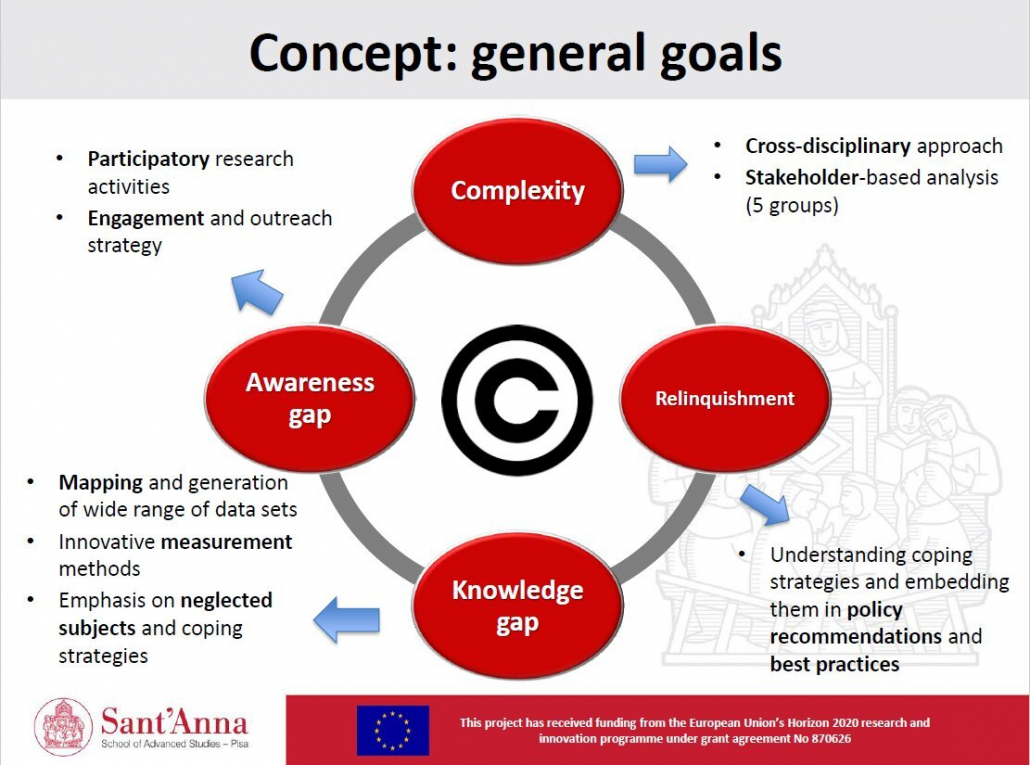
Session 1 of the webinar entailed a general introduction on the reCreating Europe project and access to digital culture by guest speaker and project coordinator, Caterina Sganga (SSSA). Caterina explained how opportunities in terms of access and affordability of cultural products brought about by digitisation are counteracted by the technical and legal obstacles to access created by copyright, which are exacerbated by poor EU harmonisation of copyright exceptions and flexibilities. Fellow guest speaker, Arianna Martinelli (SSSA), outlined the core tenets of Work Package 2 (WP2), which focuses the ongoing work to address the economic, legal and social barriers to access to digital culture for end users, including those defined as vulnerable.

Session 2 focused on the specific research of the MU unit, namely the barriers faced by vulnerable groups in accessing digital culture. Katie Donnellan opened the session with an overview of the objectives, methodology and general preliminary findings of a set of semi-structured interviews from across 12 European countries. Key stakeholders and representatives of organisations representing both old and new Minority Groups and Persons with Disabilities were interviewed by post-doc-researcher Laura Serra about the barriers they encounter in accessing digital culture. Three emerging themes were outlined:

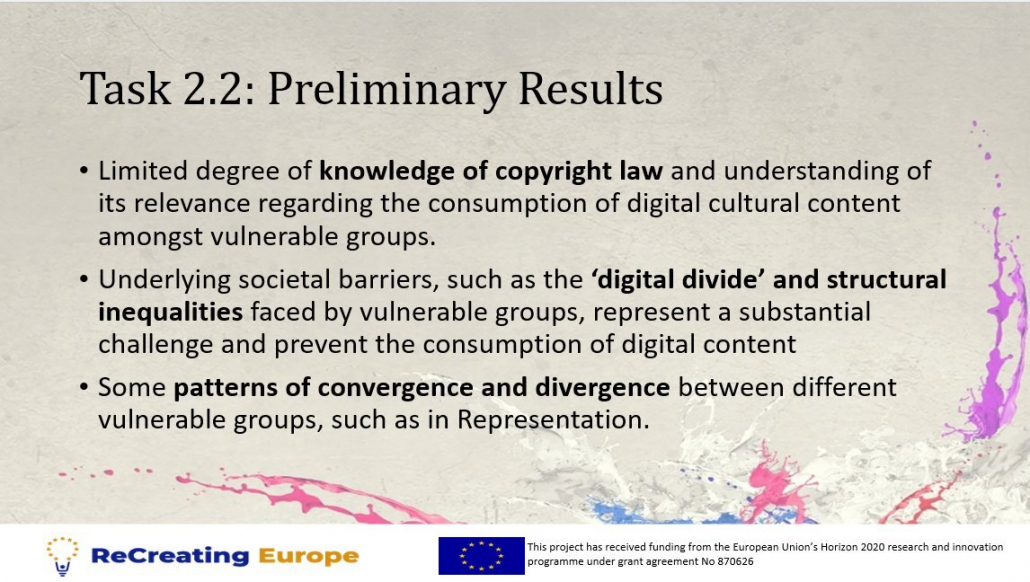
  • the existence of a limited degree of knowledge of copyright law and its relevance in the consumption of digital cultural content amongst vulnerable groups;
  • the existence of underlying societal barriers, such as the digital divide and structural inequalities faced by vulnerable groups, which represent a substantial challenge to and prevent the consumption of digital cultural content, and;
  • the existence of patterns of convergence and divergence between the different vulnerable groups, such as the underrepresentation of vulnerable groups in cultural content.
Noelle Higgins followed with a presentation of the issue of minorities and access to digital culture. Noelle outlined the research team’s broad conceptualisation of minority, which encompasses all non-dominant groups in a nation-state, that meet one or more specific criteria:

  • numerically smaller than rest of population;
  • occupy a non-dominant position in the State;
  • are culturally, linguistically, religiously or racially distinct from the majority population, and;
  • there exists a will amongst the minority group to preserve these distinctive characteristics.

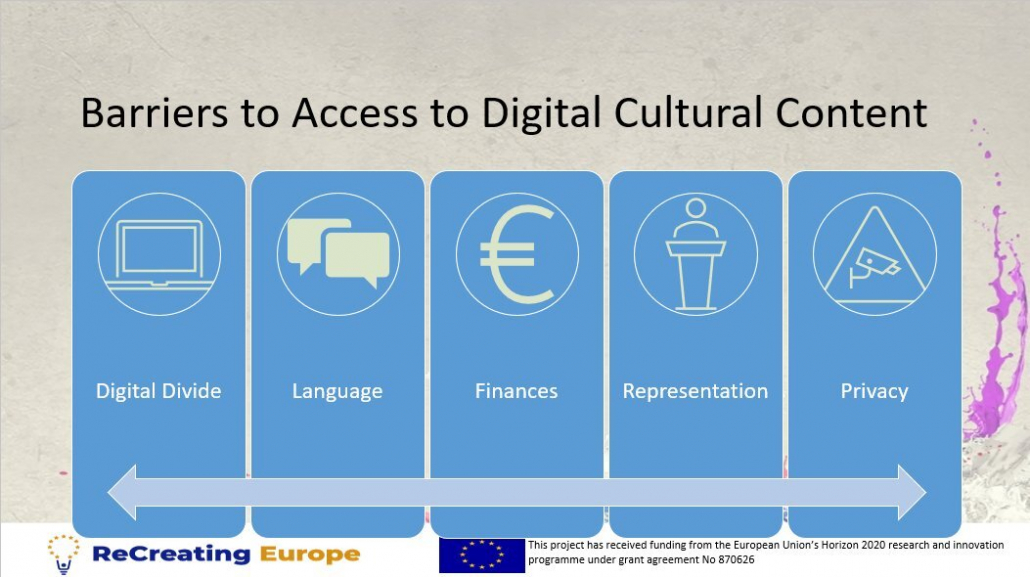
Noelle outlined the five primary barriers to accessing digital culture for minority groups identified from the research to date: the Digital Divide, language barriers, financial barriers, lack of or negative representation and privacy issues.
Delia Ferri closed Session 2 with a discussion of persons with disabilities and access to digital culture. Delia presented findings from the data collected from interviews with key informants. She highlighted that organisations of Persons with Disabilities showed a general awareness of how copyright law can hinder access to digital cultural content. Particular attention was paid to the Marrakesh Treaty to Facilitate Access to Published Works for Persons who are Blind, Visually Impaired or Otherwise Print Disabled and of EU Accessibility legislation, both of which were mentioned by interviewees as essential legal instruments, to surmount the barriers to access.
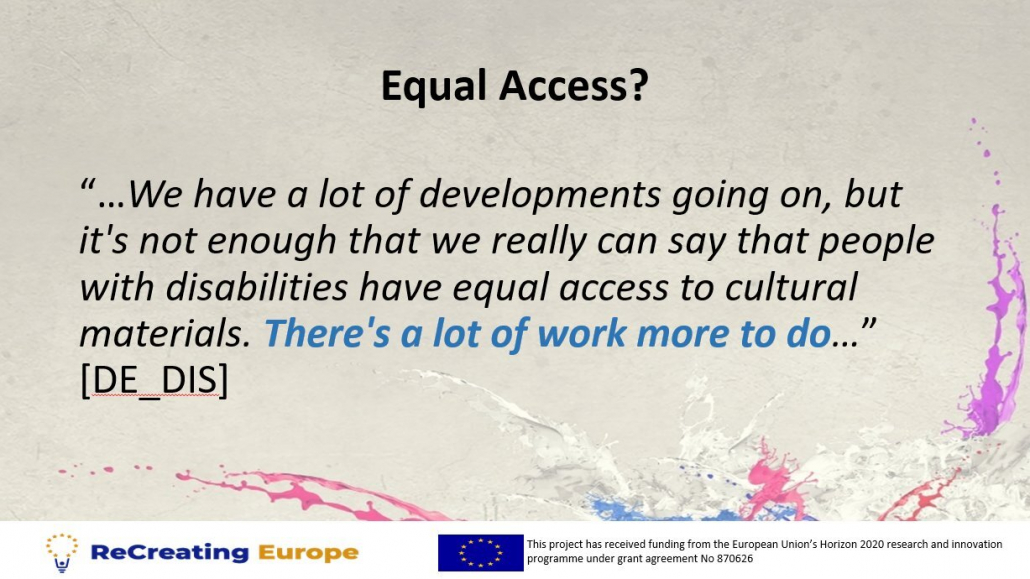
Delia outlined that, while barriers still exist to accessing digital culture for persons with disabilities, the situation is improving and there is a growing interest amongst cultural institutions and market players to make cultural goods and content accessible. Non-inclusive or negative/stereotypical representation of persons with disabilities in digital cultural content is however still an issue. All in all, whilst positive developments are underway in terms of improving access to digital cultural content for Persons with Disabilities, there remains a long road ahead.

What’s next?

This webinar marked the first of a number of dissemination events and outputs that the MU Research Team intends to host and publish in the New Year, to reflect the ongoing data analysis that they will conduct under the auspices of both Tasks 2.2 on barriers to access experienced by vulnerable groups and 2.5 on the specific case study of persons with visual impairments. This will complement the already completed dissemination outputs, such as an ALL Institute blog post, as well as those which are currently under review for publication, such as academic articles based on the research for the Cultural Trends Journal and the European Intellectual Property Review and an upcoming book chapter on ‘The Right to Culture for Asylum Seekers in Ireland: Lessons to Be Learned for the International Legal System’ in Migration and Culture: Implementation of Cultural Rights of Migrants, edited by G.C.Bruno F.M. Palombino, A. Di Stefano, G.M. Ruotolo.

The event highlighted the positive developments made thus far in terms of accessibility of digital cultural content for vulnerable groups and solidified the need for projects such as reCreating Europe to ramp up the work towards the creation of a truly modern, accessible, inclusive and diverse digital cultural landscape in Europe and beyond.

Follow reCreating Europe on Twitter, Facebook and LinkedIn to be the first to know about upcoming events from WP2 and other areas of the project.

View the speakers slides on Zenodo.

https://staging.copyrightflexibilities.eu/wp-content/uploads/2021/12/event_report_image.png 419 500 Rosie Allison https://staging.copyrightflexibilities.eu/wp-content/uploads/2020/11/recreatingEurope-logo.png Rosie Allison2021-12-14 12:10:562022-01-21 15:43:57Event report – Accessing Digital Culture: Barriers for Vulnerable Groups

Webinar (10 December) Accessing Digital Culture: Barriers for Vulnerable Groups

November 30, 2021/0 Comments/in News, Activities, End users, WP2 /by Rosie Allison

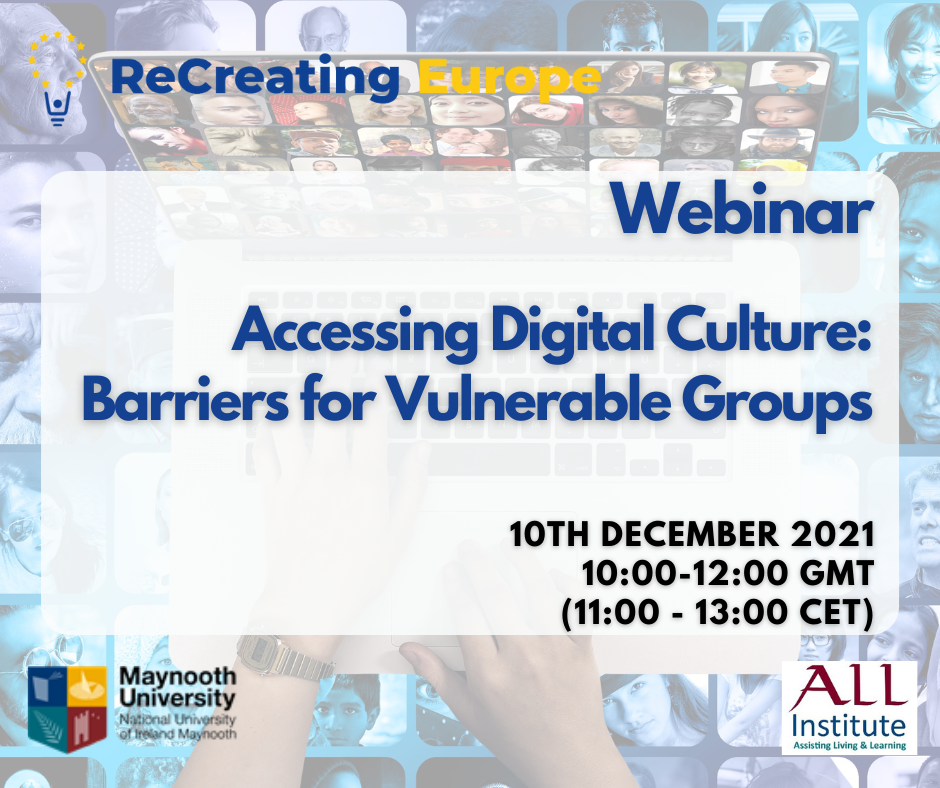
Date: 10 December 2021

Time: 10:00 to 12:00 GMT / 11:00 – 13:00 CET

Registration: https://www.eventbrite.com/e/accessing-digital-culture-barriers-for-vulnerable-groups-tickets-218051908127

Screen reader compatible poster

Screen reader compatible programme

This webinar aims to present the research conducted within the Project  Rethinking digital copyright law for a culturally diverse, accessible, creative Europe – ReCreating Europe by the Maynooth University unit. After a general introduction on the project, it discusses the preliminary findings and interim results of a set of semi-structured interviews conducted across 12 European countries with key stakeholders and representatives of organisations representing both Minority Groups and Persons with Disabilities about the barriers they encounter in accessing digital culture.

Programme

10:00 – 10:15: Welcome and Introduction – The regulatory framework of copyright content moderation at EU Level
Speakers: Delia Ferri and Noelle Higgins

Session 1 – The Project

Chair: Delia Ferri

10:15 – 10:30: The ReCreating Europe Project and Access to Digital Culture
Speaker: Caterina Sganga

10:30 – 10:45: Work Package 2 on End Users

Speaker: Arianna Martinelli

Session 2 – Barriers for Vulnerable Groups

Chair: Caterina Sganga

10:45 – 11:00: Objectives, Methodology, General Preliminary Findings
Speaker: Katie Donnellan

11:00 – 11:15 – Minorities and Access to Digital Culture

Speaker: Noelle Higgins

11:15 – 11:30: Persons with Disabilities and Access to Digital Culture

Speaker: Delia Ferri

Speakers

Delia Ferri, Professor of Law at Maynooth University and Co-director of the Assisting Living and Learning (ALL) Institute at Maynooth University.

Noelle Higgins, Associate Professor in Law at Maynooth University.

Caterina Sganga, Associate Professor in Comparative Private Law at Scuola Superiore Sant’Anna (Pisa) and ReCreating Europe project coordinator.

Arianna Martinelli, Associate Professor in Applied Economics at the Institute of Economics of Scuola Superiore Sant’Anna and Leader of Work Package 2 of the ReCreating Europe Project

Katie Donnellan, Research Assistant for the Maynooth University team of the ReCreating Europe Project, at the Maynooth University Department of Law

Registration and target audience

The webinar is free and open to all but will be targeted specifically at:

  • Academics, researchers and law students;
  • national and EU policymakers in the area of copyright law and human rights;
  • lawyers in the areas of copyright law and human rights law;
  • civil society organisations engaged with copyright and minority rights issues in the EU, and;
  • End-Users (as Project stakeholders), and in particular the project’s nominated categories of underrepresented categories who were the subjects of the interviews (Persons with Disabilities, Migrants, Members of Linguistic Minorities and Members of Ethnic Minorities, including Roma).

Register HERE

https://staging.copyrightflexibilities.eu/wp-content/uploads/2021/11/wp2_Dec_webinar_image_accessible.png 788 940 Rosie Allison https://staging.copyrightflexibilities.eu/wp-content/uploads/2020/11/recreatingEurope-logo.png Rosie Allison2021-11-30 12:57:542021-12-10 06:58:29Webinar (10 December) Accessing Digital Culture: Barriers for Vulnerable Groups
Background image: Sara Kurfess, Unsplash
Webinar (6 December) Automated Content Moderation: Copyright and Controversial Content

November 23, 2021/0 Comments/in Activities /by Rosie Allison

Date: 6 Dec 2021

Time: 10AM-11:30AM CET

Register: https://us06web.zoom.us/meeting/register/tZYrduqpqTsvGNb49iXQLXZRzeWvgR9yVy0p

Description 

This webinar will address the current status and future avenues in automated content moderation with a focus on copyright, and its implications for cultural diversity and access.  

The way platforms moderate has received increasing scrutiny and public attention over in recent years and months. With a view to copyright, the EU Directive on Copyright in the Digital Single Market (CDSM) has raised severe concerns that the included liability rules drive platforms to employ automated filtering and moderation systems much more broadly than before. This might, in turn, result in the ‘overblocking’ of non-infringing content and structurally reduce diversity and access to culture on online platforms.  

With the CDSM now being implemented in national law, this webinar follows up on the webinar previous one on the Regulatory Landscape for Copyright Content Moderation. It and takes stock of current developments and discusses potential implications for diversity and access to culture.  

In particular, the webinar will provide attendants participants with an overview, update, and critical discussion of the following key topics: 

  • Overview of the platforms’ deployment of automated content moderation systems with a focus on copyright;  
  • Learnings from the implications of automated content moderation systems for copyright and other forms of contested content such as hate speech; 
  • Discussion of implications for diversity and access to culture; 
  • Options and challenges in researching automated content moderation and its implications; 
  • Potential avenues for (automated) content moderation in the context of current EU regulation and its implications for diversity and access to culture. 

Target Audience

  • Scholars in the field of social media and platform governance research
  • Policy makers and journalists working on digital policy
  • Company representatives in policy and technology departments

Speakers

Christian Katzenbach, Professor of Media and Communication, Centre for Media, Communication and Information Research (ZeMKI), University of Bremen

João Vieira Magalhães, Assistant Professor in Media, Politics and Democracy, University of Groningen

Paloma Viejo Otero, Postdoctoral Researcher, Dublin City University,

Julia Reda, GFF / Society for Civil Rights,

Ariadna Matamoros Fernandez, Senior lecturer in Digital Media, Queensland University of Technology,


Register here

https://staging.copyrightflexibilities.eu/wp-content/uploads/2021/11/image_ACC_1.jpg 788 940 Rosie Allison https://staging.copyrightflexibilities.eu/wp-content/uploads/2020/11/recreatingEurope-logo.png Rosie Allison2021-11-23 12:41:572021-11-23 15:26:42Webinar (6 December) Automated Content Moderation: Copyright and Controversial Content

Workshop (9 December) Secondary Publishing Right — Exploring Opportunities and Limitations

November 19, 2021/0 Comments/in Activities, Galleries, Libraries, Museums & Archives, News, Workshops & Conferences, WP5 /by Rosie Allison

Date: 9 December 2021

Time: 10:00 – 11:30 CET

Registration: https://us06web.zoom.us/meeting/register/tZMsdOutqj4qHNdAyJZxelxbu_6j2GMmcwpw

Focusing on the Green Road, this workshop aims to present and discuss the second (or secondary) publication right within the context of scientific publications as a key instrument to implementing Open Access (OA). Five models will be presented from across Europe; Germany, Italy, the Netherlands, France and Belgium.

This workshop is co-organised with members of the reCreating Europe project and LIBER.

Topic

The workshop will elaborate on the second publication right which consists of the right to re-publish and communicate a work to the public. This right could be retained by the author by means of contract negotiations (to which disbalancing conditions may apply), but it is rarely applied in the current publishing context.

The right could also be granted by legislation which appears to be a more practicable and sustainable option. At present, only a handful of countries offer such a possibility, still with many limitations, despite the potential of such a right to rebalance the current distorted ecosystem of scientific communication (where scientific authors have little freedom and control over their thoughts and works).

Target Audience

This workshop is specifically tailored for libraries and archives and will include presentations and lively discussions. No prior knowledge of secondary publishing rights is necessary to participate.


* Note that this workshop has been shifted online due to the cancellation of the LIBER Winter Event (9th – 10th December 2021).

https://staging.copyrightflexibilities.eu/wp-content/uploads/2021/11/Image_WE_workshop.jpg 788 940 Rosie Allison https://staging.copyrightflexibilities.eu/wp-content/uploads/2020/11/recreatingEurope-logo.png Rosie Allison2021-11-19 12:21:322021-12-01 09:42:28Workshop (9 December) Secondary Publishing Right — Exploring Opportunities and Limitations

Webinar (16 November) The Regulatory Landscape for Copyright Content Moderation: Evaluation and Future Trajectories

October 19, 2021/0 Comments/in Activities, Workshops & Conferences, WP6 /by Rosie Allison

Date: 16 November 2021

Time: 10:00 to 11:30 CEST / Amsterdam Time 

Registration: https://us06web.zoom.us/meeting/register/tZ0scuGuqj4oH9V88UOJ8MHz6KkTSLNwixeT

This webinar will address the current status and future avenues for copyright content moderation in EU law, including a discussion on the rules on liability for online content-sharing service providers.

In particular, the webinar will provide attendants with an overview, update and critical discussion of the following key topics:

  • Recent developments at EU level surrounding copyright content moderation in the context of art. 17 of the copyright in the Digital Single Market (CDSM) Directive (2019/790) and recent Court of Justice case law;
  • The status quo of platform liability and the status of the national implementations of Art. 17 CDSM Directive in different Member States (Germany, Hungary, Italy, Sweden) and the potential impact of these on the liability of platforms and content moderation rules;
  • Potential avenues for regulation of copyright content moderation in the EU, the balancing of competing rights and interests, and their impact on access to culture.

Program

10:00 – 10:10: Welcome and background – The regulatory framework of copyright content moderation at EU Level
Speaker: JP Quintais

10:10 – 10:50: PANEL 1: Mapping the national implementation of Art. 17 CDSM Directive
Moderator: Peter Mezei

  • General remarks and framing – Peter Mezei
  • Germany – Helena Kowalewska Jahromi
  • Sweden – Kacper Szkalej
  • Italy – Giulia Priora

Q&A and Panel Discussion

10:50 – 11:25: PANEL 2: What’s to come in EU copyright content moderation?
Moderator: Sebastian Felix Schwemer

  • Measuring impact on access to culture and the future of regulation – Sebastian Felix Schwemer
  • Balancing interests through a system of “rough justice” – Thomas Riis
  • Discussant – Julia Reda

Q&A and Panel Discussion

11:25 – 11:30: Wrap-up & closing remarks
Speaker: Thomas Riis

Speakers

Helena Kowalewska Jahromi, Ass. jur., Academic Associate, Institute of International Law, Intellectual Property and Technology Law (IRGET) Faculty of Arts, Humanities and Social Science, TU Dresden (Germany)

Peter Mezei, Associate Professor, University of Szeged (Hungary); Adjunct professor (dosentti), University of Turku (Finland).

Giulia Priora, Postdoctoral Researcher, Sant’Anna School of Advanced Studies, Pisa (Italy)

João Pedro Quintais, Assistant Professor, University of Amsterdam, Institute for Information Law (IViR) (The Netherlands)

Julia Reda, Head of control © project at GFF, Fellow at the Shuttleworth Foundation, Affiliate at the Berkman Klein Center for Internet & Society (Harvard University), and former Member of the European Parliament

Thomas Riis, Professor, Centre for Information and Innovation Law (CIIR) at the University of Copenhagen (Denmark)

Sebastian Felix Schwemer, Associate Professor, Centre for Information and Innovation Law (CIIR), University of Copenhagen (Denmark); and Adjunct Associate Professor, University of Oslo’s Norwegian Research Center for Computers and Law (NRCCL) (Norway).

Kacper Szkalej, PhD, Uppsala University, lecturer in copyright, e-commerce and fundamental rights law at Lund University, Royal Institute of Technology (KTH) and Stockholm University (Sweden)

Registration and target audience

The webinar is free and open to all but will be targeted specifically at:

  • academics / researchers;
  • national and EU policymakers in the area of copyright law and regulation of online platforms;
  • lawyers in the area of copyright law and regulation of online platforms;
  • online platforms engaged with copyright content moderation issues in the EU, and;
  • civil society organisations engaged with copyright content moderation issues in the EU.

To register click HERE: 

https://staging.copyrightflexibilities.eu/wp-content/uploads/2021/10/WP6_training_webinar_logo_new.jpg 788 940 Rosie Allison https://staging.copyrightflexibilities.eu/wp-content/uploads/2020/11/recreatingEurope-logo.png Rosie Allison2021-10-19 07:45:452021-10-27 11:24:46Webinar (16 November) The Regulatory Landscape for Copyright Content Moderation: Evaluation and Future Trajectories

ReCreating Europe at EPIP 2021 

September 21, 2021/0 Comments/in Past Events, Activities, News, Workshops & Conferences, WP3 Authors and performers /by Rosie Allison

On 9 and 10 September 2021, several ReCreating Europe members participated in the 16th Annual Conference of the European Policy for Intellectual Property (EPIP) Association, dedicated to “IP and Future of Innovation” and hosted by the Centre of Humanities and Social Sciences of the Spanish National Research Council in Madrid.

The occasion was special, to say the least: for most of us, this was the first face-to-face conference since the outbreak of the pandemic. The prestigious venue of EPIP, which gathers more than 200 academics from across Europe every year, from different disciplines and backgrounds, made it incredibly meaningful for ReCreating Europe’s researchers to share the preliminary results of their work.

On September 9, the ReCreating Europe roundtable entitled ‘Centrifugal forces in EU copyright law’ took place. It was chaired by Martin Kretschmer, and participants included our project coordinator Caterina Sganga, WP3 members Ula Furgal and Thomas Margoni, WP3 leader Joost Poort, and WP6 leader João Pedro Quintais. Two illustrious respondents joined the roundtable, commenting on the research insights presented by the panelists: Brando Benifei, Member of the European Parliament, and Bence Kertész, from EU Commission DG CONNECT. See the full presentations on Zenodo.

The roundtable successfully managed to provide an overview of the main interim results of the project, highlighting gaps and dangers of today’s and tomorrow’s EU digital copyright scenario. ReCreating Europe’s researchers presented the innovative qualitative and quantitative research carried out in the past 20 months and the outcomes achieved by mapping and measuring the impact of the current multi-level legislative framework, with particular focus on copyright flexibilities, authors’ remuneration and bargaining power, copyright data ownership, transparency and AI technologies, and intermediaries and content moderation.

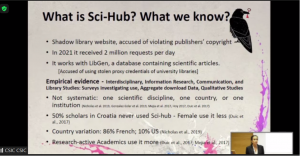
On September 10, another ReCreating Europe panel took place. This time the session was dedicated to the presentation of the results of the work conducted within WP2 on End-Users and Access to Culture. The panel featured three paper presentations: First, Giulia Rossello and Arianna Martinelli presented their ongoing empirical work under the title “Sci-Hub and Academics: Survey evidence from EU countries”, illustrating the survey they circulated across six European countries on academics’ perception of copyright law and the diffusion of academic digital piracy; Then, Giulia Priora and Caterina Sganga presented their upcoming paper “Betwitxt EU and national: the present and future of copyright flexibilities”, based on their legal mapping across all 27 Member States and related thorough comparative analysis of the legal understandings underlying EU copyright flexibilities; And finally, Peter Mezei and Istvan Harkai presented their published contribution entitled “End-user flexibilities in digital copyright law – An empirical analysis of end-user license agreements”, in which they explore the private ordering facet of copyright regulation and the way platforms’ end-users license agreements interact end-users’ freedoms and experiences. To see all the presentations from this session, they are available on Zenodo.

The EPIP conference turned out to be an incredibly fruitful moment of exchange and discussion of ReCreating Europe’s numerous preliminary results, and an important moment of assessment of the work done so far and our future plans. The cross-disciplinary research efforts and enthusiastic activities carried out since January 2020 from ReCreating Europe’s researchers met the genuine interest of academics, policymakers, and stakeholders in the audience – making the three-day-long conference not only an important moment of discussion but also an input for ReCreating Europe’s team for further work and collaborations within the scope of the project’s activities and objectives.

Stay tuned as further events will soon follow!

https://staging.copyrightflexibilities.eu/wp-content/uploads/2021/09/1.jpg 540 644 Rosie Allison https://staging.copyrightflexibilities.eu/wp-content/uploads/2020/11/recreatingEurope-logo.png Rosie Allison2021-09-21 08:56:222021-09-21 08:56:22ReCreating Europe at EPIP 2021 

ReCreating Europe at the EPIP 2021 Conference in Madrid

September 2, 2021/0 Comments/in Workshops & Conferences, Activities /by Rosie Allison

On 8-10 September 2021, ReCreating Europe will join the 16th Annual Conference of the EPIP (European Policy for Intellectual Property) Association “IP and Future of Innovation”, hosted by the Centre of Humanities and Social Sciences of the Spanish National Research Council in Madrid.

This independent, interdisciplinary, non-profit association of researchers from all over the world will gather to share and discuss high profile projects and ideas in the field of intellectual property, including copyright law.

This year ReCreating Europe will participate, bringing to the tables of the conference research outcomes and key developments across its Work Packages.

9th September 10:15 CEST – Roundtable: ‘Centrifugal forces in EU copyright law’

ReCreating Europe will host a round table on the “Centrifugal forces in EU copyright law”. The discussion will focus on the outcomes achieved by mapping and measuring the impact of the current multi-level legislative framework on:

(a) copyright flexibilities, users’ rights, access to culture and vulnerable groups;

(b) authors’ remuneration, income distribution and bargaining power, with a special focus on reversion rights; (c) copyright, data ownership, transparency and AI technologies; and

(d) intermediaries, content moderation, access to culture and freedom of (creative) expression.

ReCreating Europe researchers Ula Furgal, Thomas Margoni, Joost Poort, João Pedro Quintais, and Caterina Sganga will discuss preliminary results together with Brando Benifei (European Parliament), Bence Kertesz (DG CNCT) and Judge Marko Ilesic (TBC).

10th September 12:00 CEST – Paper presentations

Another ReCreating Europe panel will be dedicated to the presentation of the results of the work conducted within Work Package 2 on End-Users and Access to Culture. The panel will feature three paper presentations:

  • Giulia Priora and Caterina Sganga will share insights from their upcoming paper “Betwitxt and between: the present and future of copyright flexibilities”, tracing the contours of their encompassing research efforts mapping public legal sources of copyright flexibilities at EU as well as national level. The paper closely looks at the varying legal takes and understandings surrounding the notion of copyright flexibilities, and draws examples from selected copyright exceptions (non-commercial private uses, educational and research uses, and cultural heritage preservation) to build a comprehensive assessment of the consistency and effectiveness of current and future regulation.
  • Peter Mezei and Istvan Harkai will fundamentally complement the picture on copyright flexibilities presenting their paper on “End-user flexibilities in digital copyright law – An empirical analysis of end-user license agreements”. Exploring the private ordering facet of copyright regulation, their contribution thoroughly illustrates the way platforms’ end-users license agreements interact and shape copyright flexibilities, enabling or rather restricting their exercise and viability. The empirical analysis conducted embraces seventeen popular online service providers, and is available here.
  • Giulia Rossello and Arianna Martinelli will present their paper “Sci-Hub and Academics: Survey evidence from EU countries”. Leveraging on original data collected through an online survey in six European countries (Italy, Ireland, Sweden, Germany, Hungary, The Netherlands) the paper provides an overview on academics’ perception of copyright law and the diffusion of academic digital piracy.

To register to the conference and attend ReCreating Europe’s panels amongst a stellar line-up of other speakers and insightful presentations, visit the EPIP website: https://epip2021.org/registration/.

https://staging.copyrightflexibilities.eu/wp-content/uploads/2021/09/ReCreating_at_EPIP.jpg 788 940 Rosie Allison https://staging.copyrightflexibilities.eu/wp-content/uploads/2020/11/recreatingEurope-logo.png Rosie Allison2021-09-02 13:06:012021-09-02 13:06:01ReCreating Europe at the EPIP 2021 Conference in Madrid
Page 2 of 3123

Pages

  • Activities & Resources
  • ADVISORY BOARD
  • Back online soon…
  • Contact us
  • Cookie Policy
  • Databases and datasets
  • Final Conference Programme
  • forumup
  • Groups
  • Home
  • News & Events
  • Newsletter ReCreating Europe
  • PEOPLE
  • Policy papers
  • Policy recommendations, guidelines, best practices
  • Privacy Policy
  • Reports and studies
  • Stakeholders
  • The Consortium
  • THE PROJECT

Categories

  • Activities
  • Creative industries
  • End users
  • Galleries, Libraries, Museums & Archives
  • Intermediaries
  • Mapping, Measuring, Studying
  • News
  • Past Events
  • Stakeholders
  • Workshops & Conferences
  • WP2
  • WP3 Authors and performers
  • WP5
  • WP6
  • WP7

Archive

  • March 2023
  • January 2023
  • December 2022
  • November 2022
  • October 2022
  • August 2022
  • June 2022
  • April 2022
  • January 2022
  • December 2021
  • November 2021
  • October 2021
  • September 2021
  • August 2021
  • July 2021
  • June 2021
  • April 2021
  • March 2021
  • December 2020
  • September 2020
  • July 2020
  • May 2020

CC BY reCreating Europe
Privacy Policy | Cookie Policy

Sitemap

  • THE PROJECT
  • THE CONSORTIUM
  • PEOPLE
  • STAKEHOLDERS
  • ACTIVITIES & RESOURCES
  • NEWS
  • NEWSLETTER
  • CONTACT US

The Coordinator

Scuola Superiore Sant’Anna
Piazza Martiri della Libertà, 33
56127 Pisa
Italy

Social

This project is funded by
the European Union

This project has received funding from the European Union’s Horizon 2020 research and innovation programme under grant agreement No 870626

Scroll to top